If you see any Dead link in Any Post...
Then please report immediately on our FACEBOOK Account or COMMENT Below of that Post...
It'll Help us to maintain our Blog and assurance of 100% Original Links.
Thanks... ADMIN...
Showing posts with label 5th Semester Computer Science. Show all posts

February 14, 2014

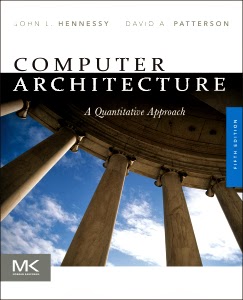
Solution Manual of Computer Architecture A Quantitative Approach 4th Edition by John L Hennessy and David Patterson

Solution Manual of Computer Architecture - A Quantitative Approach
Solution Manual of Computer
Architecture
Book Name: Computer Architecture - A Quantitative Approach
Author Name: David A. Patterson
John L. Hennessy
Edition: 4th Edition, , illustrated, revised
Publisher: Morgan Kaufmann, 2006
ISBN: 0123704901, 978-0123704900
File Size: 264 KB
Type: Solution Manual

Download Solution Manual here.
Download 

Its in PDF format if you don't have Adobe Reader then please 1st download it.
Download Adobe Reader 

Description:
The era of seemingly unlimited growth in processor performance is over: single chip architectures can no longer overcome the performance limitations imposed by the power they consume and the heat they generate. Today, Intel and other semiconductor firms are abandoning the single fast processor model in favor of multi-core microprocessors--chips that combine two or more processors in a single package. In the fourth edition of Computer Architecture, the authors focus on this historic shift, increasing their coverage of multiprocessors and exploring the most effective ways of achieving parallelism as the key to unlocking the power of multiple processor architectures. Additionally, the new edition has expanded and updated coverage of design topics beyond processor performance, including power, reliability, availability, and dependability.

CD System Requirements:
PDF Viewer
The CD material includes PDF documents that you can read with a PDF viewer such as Adobe, Acrobat or Adobe Reader. Recent versions of Adobe Reader for some platforms are included on the CD.

HTML Browser
The navigation framework on this CD is delivered in HTML and JavaScript. It is recommended that you install the latest version of your favorite HTML browser to view this CD. The content has been verified under Windows XP with the following browsers: Internet Explorer 6.0, Firefox 1.5, Google Chrome 23; under Mac OS X (Panther) with the following browsers: Internet Explorer 5.2, Firefox 1.0.6, Safari 1.3; and under Mandriva Linux 2006 with the following browsers: Firefox 1.0.6, Konqueror 3.4.2, Mozilla 1.7.11
The content is designed to be viewed in a browser window that is at least 720 pixels wide. You may find the content does not display well if your display is not set to at least 1024x768 pixel resolution.

Operating System
This CD can be used under any operating system that includes an HTML browser and a PDF viewer. This includes Windows, Mac OS, and most Linux and Unix systems.

Increased coverage on achieving parallelism with multiprocessors.

Case studies of latest technology from industry including the Sun Niagara Multiprocessor, AMD Opteron, and Pentium 4.

Three review appendices, included in the printed volume, review the basic and intermediate principles the main text relies upon.

Eight reference appendices, collected on the CD, cover a range of topics including specific architectures, embedded systems, application specific processors--some guest authored by subject experts.

September 14, 2013

Web Engineering Lecture Slides

Here are all Lecture Slides of Web Engineering. Course Instructor is Sir Usman Akram. Please check these out.
Download these lecture Slides here.
Lecture’s Details
Link
Lecture 1(Internet & WWW)
Lecture 2(HTML & CSS Basics)
Lecture 3(More Basic HTML & CSS)
Lecture 4(Page Selections & CSS Box Model)
Lecture 5(Floating & Positioning)
Lecture 6 (PHP & Server Side Language)


Adobe Reader (Updated) 
Any issue or confusion??? Drop a comment below in comment box or contact us on Facebook.

To Prevent Mediafire Ads Download AdBlock Plus
For ChromeInstall
For MozillaInstall 

January 3, 2013

Operating Systems Design and Implementation by Andrew S Tanenbaum Third Edition

Operating Systems Design  and Implementation
Operating Systems Design
and Implementation
Book Name : Operating Systems Design and Implementation
Author Name : Andrew S. Tanenbaum
Publisher : Prentice Hall
Pub Date : January 04, 2006
Print ISBN-10 : 0-13-142938-8
Print ISBN-13 : 978-0-13-142938-3
eText ISBN-10 : 0-13-185991-9
eText ISBN-13 : 978-0-13-185991-3
Pages : 1080
Type : Ebook, PDF

Text Book here.

Download 


Its in PDF format if you don't have Adobe Reader then please 1st download it.
Download Adobe Reader


For the latest version of MINIX and simulators for running MINIX on other systems visit: www.minix3.org

Revised to address the latest version of MINIX (MINIX 3), this streamlined, simplified new edition remains the only operating systems text to first explain relevant principles, then demonstrate their applications using a Unix-like operating system as a detailed example. It has been especially designed for high reliability, for use in embedded systems, and for ease of teaching.


Table of Contents:

CHAPTER 1: INTRODUCTION
1.1 WHAT IS AN OPERATING SYSTEM?
1.2 HISTORY OF OPERATING SYSTEMS
1.3 OPERATING SYSTEM CONCEPTS
1.4 SYSTEM CALLS
1.5 OPERATING SYSTEM STRUCTURE
1.6 OUTLINE OF THE REST OF THIS BOOK
1.7 SUMMARY

CHAPTER 2: PROCESSES
2.1 INTRODUCTION TO PROCESSES
2.2 INTERPROCESS COMMUNICATION
2.3 CLASSICAL IPC PROBLEMS
2.4 SCHEDULING
2.5 OVERVIEW OF PROCESSES IN MINIX 3
2.6 IMPLEMENTATION OF PROCESSES IN MINIX 3
2.7 THE SYSTEM TASK IN MINIX 3
2.8 THE CLOCK TASK IN MINIX 3
2.9 SUMMARY

CHAPTER 3: INPUT/OUTPUT
3.1 PRINCIPLES OF I/O HARDWARE
3.2 PRINCIPLES OF I/O SOFTWARE
3.3 DEADLOCKS
3.4 OVERVIEW OF I/O IN MINIX 3
3.5 BLOCK DEVICES IN MINIX 3
3.6 RAM DISKS
3.7 DISKS
3.8 TERMINALS
3.9 SUMMARY

CHAPTER 4: MEMORY MANAGEMENT
4.1 BASIC MEMORY MANAGEMENT
4.2 SWAPPING
4.3 VIRTUAL MEMORY
4.4 PAGE REPLACEMENT ALGORITHMS
4.5 DESIGN ISSUES FOR PAGING SYSTEMS
4.6 SEGMENTATION
4.7 OVERVIEW OF THE MINIX 3 PROCESS MANAGER
4.8 IMPLEMENTATION OF THE MINIX 3 PROCESS MANAGER
4.9 SUMMARY
CHAPTER 5: FILE SYSTEMS
5.1 FILES
5.2 DIRECTORIES
5.3 FILE SYSTEM IMPLEMENTATION
5.4 SECURITY
5.5 PROTECTION MECHANISMS
5.6 OVERVIEW OF THE MINIX 3 FILE SYSTEM
5.7 IMPLEMENTATION OF THE MINIX 3 FILE SYSTEM
5.8 SUMMARY

CHAPTER 6: READING LIST AND BIBLIOGRAPHY
6.1 SUGGESTIONS FOR FURTHER READING
6.2 ALPHABETICAL BIBLIOGRAPHY

APPENDIX A - INSTALLING MINIX 3
APPENDIX B - MINIX 3 SOURCE CODE LISTING
APPENDIX C - INDEX TO FILES INDEX


December 28, 2012

Modern Operating Systems 2nd Edition by Andrew S Tanenbaum


Download Ebook here.
Download 


The widely anticipated revision of this worldwide best-seller incorporates the latest developments in operating systems technologies. The Third Edition includes up-to-date materials on relevant operating systems such as Linux, Windows, and embedded real-time and multimedia systems. Includes new and updated coverage of multimedia operating systems, multiprocessors, virtual machines, and antivirus software. Covers internal workings of Windows Vista (Ch. 11); unique even for current publications. Provides information on current research based Tanenbaum's experiences as an operating systems researcher. A useful reference for programmers.

March 11, 2012

Computer Organization and Design by Patterson and Hennesy - 3rd Edition


Computer Organization and Design
Book Name: Computer Organization and Design
The Hardware/Software Interface
Author Name: David A. Patterson
John L. Hennessy
Edition: Third Edition, , illustrated, revised
Publisher: Morgan Kaufmann, 2009
ISBN: 0123744938, 9780123744937
Type: Text Book

Download Text Book here.
Download 

Its in PDF format if you don't have Adobe Reader then please 1st download it.
Download Adobe Reader 

Description:
The best-selling computer organization book is thoroughly updated to provide a new focus on the revolutionary change taking place in industry today: the switch from uniprocessor to multicore microprocessors. This new emphasis on parallelism is supported by updates reflecting the newest technologies, with examples highlighting the latest processor designs and benchmarking standards. As with previous editions, a MIPS processor is the core used to present the fundamentals of hardware technologies, assembly language, computer arithmetic, pipelining, memory hierarchies and I/O. Sections on the ARM and x86 architectures are also included.
A companion CD provides a toolkit of simulators and compilers along with tutorials for using them, as well as advanced content for further study and a search utility for finding content on the CD and in the printed text.
  • Covers the revolutionary change from sequential to parallel computing, with a new chapter on parallelism and sections in every chapter highlighting parallel hardware and software topics.
  • Includes a new appendix by the Chief Scientist and the Director of Architecture of NVIDIA covering the emergence and importance of the modern GPU, describing in detail for the first time the highly parallel, highly multithreaded multiprocessor optimized for visual computing.
  • Describes a novel approach to measuring multicore performance--the "Roofline model"--with benchmarks and analysis for the AMD Opteron X4, Intel Xeon 5000, Sun UltraSPARC T2, and IBM Cell.
  • Includes new content on Flash memory and Virtual Machines.
  • Provides a large, stimulating set of new exercises, covering almost 200 pages.
  • Features the AMD Opteron X4 and Intel Nehalem as real-world examples throughout the book.
  • Updates all processor performance examples using the SPEC CPU2006 suite.