If you see any Dead link in Any Post...
Then please report immediately on our FACEBOOK Account or COMMENT Below of that Post...
It'll Help us to maintain our Blog and assurance of 100% Original Links.
Thanks... ADMIN...
Showing posts with label Electrical Engineering Solutions. Show all posts

November 27, 2014

Solution Manual of Engineering Electromagnetics by Hayt and Buck

Engineering Electromegnatics
Book Name: Engineering Electromagnetics
Author Name:
William H. Hayt Jr.
John A. Buck
Edition: 7th Edition
Type: Solution Manual

Download Solution Manual here.
Download

Its in PDF format if you don't have Adobe Reader then please 1st download it.
Download Adobe Reader 

Engineering Electromagnetics is a "classic" book that has been updated for electromagnetics in today's world. It is designed for introductory courses in electromagnetics or electromagnetic field theory at the junior-level, but can also be used as a professional reference. This widely respected book stresses fundamentals and problem solving and discusses the material in an understandable, readable way. Numerous illustrations and analogies are provided to the aid the reader in grasping difficult concepts. In addition, independent learning is facilitated by the presence of many examples and problems.
This site contains helpful resources for instructors and students. If you click on the Information Center link on the left, you will find the following: About the Authors, Book Preface, Book Walkthrough, Table of Contents, and PageOut (a useful tool creating an instructor's website).

October 8, 2014

Solution Manual of Signals and Systems by Oppenheim 2nd Edition

Signals and Systems by Oppenheim
Signals and Systems
by Oppenheim
Book Name: Signals & Systems
Author Name:
Alan V. Oppenheim
Alan S. Willsky
Edition: Second Edition, (August 16, 1996)
Publisher: Prentice Hall
Pages: 116 pages
Size: 22.4 MB
ISBN-10: 0138147574
ISBN-13: 978-0138147570
Type: Soltuon Manual

Download Soltuon Manual here.
Download 

Its in PDF format if you don't have Adobe Reader then please 1st download it.
Download Adobe Reader 
Give A Comment
The second edition of this well-known and highly regarded text can be used as the basis for a one- or two-semester undergraduate course in signals and linear systems theory and applications. Topics include basic signals and systems concepts, linear time-invariant (LTI) systems, Fourier representations of continuous-time and discrete-time signals, the CT and DT Fourier transforms, and time- and frequency-domain analysis methods. The author emphasizes applications of the theory through numerous examples in filtering, sampling, communications, and feedback. The parallel development of continuous-time and discrete-time frequency domain methods allows the reader to apply insights and intuition across the two domains. It also facilitates a deeper understanding of the material by bringing into focus the similarities and differences between the two domains. The text also includes introductory chapters on communication systems and control theory. This book assumes that you have a background in calculus as well as exposure to complex numbers and elementary differential equations. Because of its thoroughness and unhurried pace, this text is highly recommended for students and those interested in self-study. 

Product Description
This comprehensive book of signals and systems develops continuous-time and discrete-time concepts/methods. Highly regarded for its intellectual quality, it provides a solid foundation and life-long reference for anyone studying the most important methods or modern signal and system analysis.

Table of Contents
(NOTE: Each chapter begins with an Introduction and concludes with a Summary.)

1. Signals and Systems. 
Continuous-Time and Discrete-Time Signals. Transformations of the Independent Variable. Exponential and Sinusoidal Signals. The Unit Impulse and Unit Step Functions. Continuous-Time and Discrete-Time Systems. Basic System Properties.

2. Linear Time-Invariant Systems. 
Discrete-Time LTI Systems: The Convolution Sum. Continuous-Time LTI Systems: The Convolution Integral. Properties of Linear Time-Invariant Systems. Causal LTI Systems Described by Differential and Difference Equations. Singularity Functions.

3. Fourier Series Representation of Periodic Signals. 
A Historical Perspective. The Response of LTI Systems to Complex Exponentials. Fourier Series Representation of Continuous-Time Periodic Signals. Convergence of the Fourier Series. Properties of Continuous-Time Fourier Series. Fourier Series Representation of Discrete-Time Periodic Signals. Properties of Discrete-Time Fourier Series. Fourier Series and LTI Systems. Filtering. Examples of Continuous-Time Filters Described by Differential Equations. Examples of Discrete-Time Filters Described by Difference Equations.

4. The Continuous-Time Fourier Transform. 
Representation of Aperiodic Signals: The Continuous-Time Fourier Transform. The Fourier Transform for Periodic Signals. Properties of the Continuous-Time Fourier Transform. The Convolution Property. The Multiplication Property. Tables of Fourier Properties and Basic Fourier Transform Pairs. Systems Characterized by Linear Constant-Coefficient Differential Equations.

5. The Discrete-Time Fourier Transform. 
Representation of Aperiodic Signals: The Discrete-Time Fourier Transform. The Fourier Transform for Periodic Signals. Properties of the Discrete-Time Fourier Transform. The Convolution Property. The Multiplication Property. Tables of Fourier Transform Properties and Basic Fourier Transform Pairs. Duality. Systems Characterized by Linear Constant-Coefficient Difference Equations.

6. Time- and Frequency Characterization of Signals and Systems. 
The Magnitude-Phase Representation of the Fourier Transform. The Magnitude-Phase Representation of the Frequency Response of LTI Systems. Time-Domain Properties of Ideal Frequency-Selective Filters. Time- Domain and Frequency-Domain Aspects of Nonideal Filters. First-Order and Second-Order Continuous-Time Systems. First-Order and Second-Order Discrete-Time Systems. Examples of Time- and Frequency-Domain Analysis of Systems.

7. Sampling. 
Representation of a Continuous-Time Signal by Its Samples: The Sampling Theorem. Reconstruction of a Signal from Its Samples Using Interpolation. The Effect of Under sampling: Aliasing. Discrete-Time Processing of Continuous-Time Signals. Sampling of Discrete-Time Signals.

8. Communication Systems. 
Complex Exponential and Sinusoidal Amplitude Modulation. Demodulation for Sinusoidal AM. Frequency-Division Multiplexing. Single-Sideband Sinusoidal Amplitude Modulation. Amplitude Modulation with a Pulse-Train Carrier. Pulse-Amplitude Modulation. Sinusoidal Frequency Modulation. Discrete-Time Modulation.

9. The Laplace Transform. 
The Laplace Transform. The Region of Convergence for Laplace Transforms. The Inverse Laplace Transform. Geometric Evaluation of the Fourier Transform from the Pole-Zero Plot. Properties of the Laplace Transform. Some Laplace Transform Pairs. Analysis and Characterization of LTI Systems Using the Laplace Transform. System Function Algebra and Block Diagram Representations. The Unilateral Laplace Transform.

10. The Z-Transform. 
The z-Transform. The Region of Convergence for the z-Transform. The Inverse z-Transform. Geometric Evaluation of the Fourier Transform from the Pole-Zero Plot. Properties of the z-Transform. Some Common z-Transform Pairs. Analysis and Characterization of LTI Systems Using z-Transforms. System Function Algebra and Block Diagram Representations. The Unilateral z-Transforms.

11. Linear Feedback Systems. 
Linear Feedback Systems. Some Applications and Consequences of Feedback. Root-Locus Analysis of Linear Feedback Systems. The Nyquist Stability Criterion. Gain and Phase Margins.

Appendix: Partial-Fraction Expansion. 
Bibliography. 
Answers. 
Index. 

March 25, 2014

Solution Manual of Digital Signal Processing by Proakis Manolakis 4th Edition

Digital Signal Processing
Book Name: Digital Signal Processing
Author Name: John G. Proakis
Dimitris G. Manolakis
Edition: 4th Edition
Type: Solution Manual
Pages: 432
File Size: 2.38 MB

Download Solution Manual here.
Download

Its in PDF format if you don't have Adobe Reader then please 1st download it.
Download Adobe Reader 

Contents:
Introduction
Discrete-Time Signals And Systems
The Z-Transform And Its Application To The Analysis Of LTI Systems
Frequency Analysis Of Signals And Systems
Frequency Domain Analysis Of Lti Systems
Sampling And Reconstruction Of Signals
The Discrete Fourier Transform: Its Properties and Applications
Efficient Computaiton Of The Dft: Fast Fourier Transform Algorithms
Implementation Of Discrete-Time Systems
Design Of Digital Filers
Multirate Digital Signal Processing
Linear Prediction And Optimum Linear Filters
Adaptive Filters
Power Spectrum Estimation

February 14, 2014

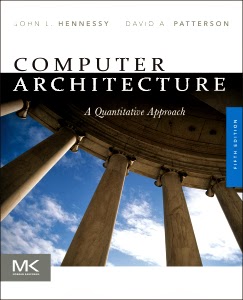
Solution Manual of Computer Architecture A Quantitative Approach 4th Edition by John L Hennessy and David Patterson

Solution Manual of Computer Architecture - A Quantitative Approach
Solution Manual of Computer
Architecture
Book Name: Computer Architecture - A Quantitative Approach
Author Name: David A. Patterson
John L. Hennessy
Edition: 4th Edition, , illustrated, revised
Publisher: Morgan Kaufmann, 2006
ISBN: 0123704901, 978-0123704900
File Size: 264 KB
Type: Solution Manual

Download Solution Manual here.
Download 

Its in PDF format if you don't have Adobe Reader then please 1st download it.
Download Adobe Reader 

Description:
The era of seemingly unlimited growth in processor performance is over: single chip architectures can no longer overcome the performance limitations imposed by the power they consume and the heat they generate. Today, Intel and other semiconductor firms are abandoning the single fast processor model in favor of multi-core microprocessors--chips that combine two or more processors in a single package. In the fourth edition of Computer Architecture, the authors focus on this historic shift, increasing their coverage of multiprocessors and exploring the most effective ways of achieving parallelism as the key to unlocking the power of multiple processor architectures. Additionally, the new edition has expanded and updated coverage of design topics beyond processor performance, including power, reliability, availability, and dependability.

CD System Requirements:
PDF Viewer
The CD material includes PDF documents that you can read with a PDF viewer such as Adobe, Acrobat or Adobe Reader. Recent versions of Adobe Reader for some platforms are included on the CD.

HTML Browser
The navigation framework on this CD is delivered in HTML and JavaScript. It is recommended that you install the latest version of your favorite HTML browser to view this CD. The content has been verified under Windows XP with the following browsers: Internet Explorer 6.0, Firefox 1.5, Google Chrome 23; under Mac OS X (Panther) with the following browsers: Internet Explorer 5.2, Firefox 1.0.6, Safari 1.3; and under Mandriva Linux 2006 with the following browsers: Firefox 1.0.6, Konqueror 3.4.2, Mozilla 1.7.11. 
The content is designed to be viewed in a browser window that is at least 720 pixels wide. You may find the content does not display well if your display is not set to at least 1024x768 pixel resolution.

Operating System
This CD can be used under any operating system that includes an HTML browser and a PDF viewer. This includes Windows, Mac OS, and most Linux and Unix systems.

Increased coverage on achieving parallelism with multiprocessors.

Case studies of latest technology from industry including the Sun Niagara Multiprocessor, AMD Opteron, and Pentium 4.

Three review appendices, included in the printed volume, review the basic and intermediate principles the main text relies upon.

Eight reference appendices, collected on the CD, cover a range of topics including specific architectures, embedded systems, application specific processors--some guest authored by subject experts.

February 12, 2014

Solution Manual for Probability Statistics and Random Processes for Electrical Engineering by Alberto Leon-Garcia

Solution Manual for Probability
Statistics and Random
Processes for Electrical
Engineering
Book Name: Probability Statistics and Random Processes for Electrical Engineering
Author Name: Alberto Leon-Garcia
Edition: 4th Edition
Type: Solution Manual
Pages: 42 Parts
Size: 8.32 MB (.rar File)

Download Solution Manual here.
Download 

Its in PDF format if you don't have Adobe Reader then please 1st download it.
Download Adobe Reader 

About Author:
This is the standard textbook for courses on probability and statistics, not substantially updated. While helping students to develop their problem-solving skills, the author motivates students with practical applications from various areas of ECE that demonstrate the relevance of probability theory to engineering practice. Included are chapter overviews, summaries, checklists of important terms, annotated references, and a wide selection of fully worked-out real-world examples. In this edition, the Computer Methods sections have been updated and substantially enhanced and new problems have been added.

November 12, 2013

Solutions of Digital Design by Morris Mano Fourth Edition


Digital Design 4th Edition
Book Name: Digital Design
Author Name:
1: M. MORRIS MANO
2: MICHAEL D. CILETT
ISBN: 0131217887, 9780131217881
Publisher: Prentice Hall, 2002
Edition: 4th Edition
Type: Solution Manual
Size: 1.83 MB

Download Solution Manual here.
Download 

Its in PDF format if you don't have Adobe Reader then please 1st download it.
Download Adobe Reader 

Contents:
Binary Systems, 
Boolean Algebra and Logic Gates, 
Asynchronous Sequential Logic,
Combinational Logic, 
Gate-Level Minimization, 
Registers and Counters, 
Memory and Programmable Logic, 
Register Transfer Level,  
Digital Integrated Circuits.

Details:
For sophomore courses on digital design in an Electrical Engineering, Computer Engineering, or Computer Science department. & Digital Design, fourth edition is a modern update of the classic authoritative text on digital design.& This book teaches the basic concepts of digital design in a clear, accessible manner. The book presents the basic tools for the design of digital circuits and provides procedures suitable for a variety of digital applications.

October 19, 2013

Solution Manual of Fundamentals of Electric Circuits by Charles Alexander 4th Edition

Solution Manual of Fundamentals of Electric Circuits by Charles Alexander 4th Edition
Fundamentals of Electric Circuits
Book Name: Fundamentals of Electric Circuits
Author Name:
Charles Alexander
Matthew N. O. Sadiku
Edition: Forth Edition
Type: Solution Manual

Download Solution Manual here.
Download

Its in PDF format if you don't have Adobe Reader then please 1st download it.
Download Adobe Reader 

Alexander and Sadiku's third edition of Fundamentals of Electric Circuits continues in the spirit of its successful previous editions, with the objective of presenting circuit analysis in a manner that is clearer, more interesting, and easier to understand than the competition. Students are introduced to the sound, six-step problem solving methodology in chapter one, and are consistently made to apply and practice these steps in practice problems and homework problems throughout the text and online using the KCIDE for Circuits software.
A balance of theory, worked examples and extended examples, practice problems, and real-world applications, combined with over 300 new homework problems for the third edition and robust media offerings, renders the third edition the most comprehensive and student-friendly approach to linear circuit analysis.

November 20, 2012

Solution Manual of Electric Machinery Fundamentals by Chapman 4th Edition


Electric Machinery Fundamentals
Electric Machinery
Fundamentals
Book Name: Electric Machinery Fundamentals
Author Name: Stephen J. Chapman
File Size: 4.99 MB
Type: Solution Manual
Edition: 4, illustrated

Download Solution Manual here.
Download

Its in PDF format if you don't have Adobe Reader then please 1st download it.
Download Adobe Reader 

Details:
Electric Machinery Fundamentals continues to be a best-selling machinery text due to its accessible, student-friendly coverage of the important topics in the field. Chapman's clear writing persists in being one of the top features of the book.
Although not a book on MATLAB, the use of MATLAB has been enhanced in the fourth edition. Chapman has also added some new applications, as well as many new problems have been added.
Electric Machinery Fundamentals is also accompanied by a website the provides solutions for instructors, as well as source code, MATLAB tools, and links to important sites for students.

November 16, 2012

Control Systems Engineering by Norman S Nise Solution Manual Skill Assignment

Control System Engineering

Book Name: CONTROL SYSTEMS ENGINEERING
Author Name: Norman S. Nise
Edition:  Third Edition (Also same for all Editions upto 6th)
Type: Sill Assignments-Solution Manual
Size: 765 KB
Download Solution Manual here.
Download 


Its in PDF format if you don't have Adobe Reader then please 1st download it.
Download Adobe Reader 

Details:
Emphasizing the practical application of control systems engineering, the new Fourth Edition shows how to analyze and design real-world feedback control systems. Readers learn how to create control systems that support today's advanced technology and apply the latest computer methods to the analysis and design of control systems.
* A methodology with clearly defined steps is presented for each type of design problem.
* Continuous design examples give a realistic view of each stage in the control systems design process.
* A complete tutorial on using MATLAB Version 5 in designing control systems prepares readers to use this important software tool.

Chapters:

1. INTRODUCTION
2. MODELING IN THE FREQUENCY DOMAIN
3. MODELING IN THE TIME DOMAIN
4. TIME RESPONSE
5. REDUCTION OF MULTIPLE SUBSYSTEM
6. STABILITY
7. STEADY-STATE ERRORS
8. ROOT LOCUS TECHNIQUES
9. DESIGN VIA ROOT LOCUS
10. FREQUENCY RESPONSE TECHNIQUES
11. DESIGN VIA FREQUENCY RESPONSE
12. DESIGN VIA STATE SPACE
13. DIGITAL CONTROL SYSTEMS

November 11, 2012

Solution Manual of Computer Organization and Design by Patterson and Hennessy

Computer Organization and Design - Solution Manual
Computer Organization and
Design - Solution Manual
Book Name: Computer Organization and Design
The Hardware/Software Interface
Author Name: David A. Patterson
John L. Hennessy
Edition: Edition, , illustrated, revised
Publisher: Morgan Kaufmann, 2009
ISBN: 0123744938, 9780123744937
File Size: 6.20 MB
Type: Solution Manual

Download Solution Manual here.
Download 

Its in PDF format if you don't have Adobe Reader then please 1st download it.
Download Adobe Reader 

Description:
The best-selling computer organization book is thoroughly updated to provide a new focus on the revolutionary change taking place in industry today: the switch from uniprocessor to multicore microprocessors. This new emphasis on parallelism is supported by updates reflecting the newest technologies, with examples highlighting the latest processor designs and benchmarking standards. As with previous editions, a MIPS processor is the core used to present the fundamentals of hardware technologies, assembly language, computer arithmetic, pipelining, memory hierarchies and I/O. Sections on the ARM and x86 architectures are also included.
A companion CD provides a toolkit of simulators and compilers along with tutorials for using them, as well as advanced content for further study and a search utility for finding content on the CD and in the printed text.
  • Covers the revolutionary change from sequential to parallel computing, with a new chapter on parallelism and sections in every chapter highlighting parallel hardware and software topics.
  • Includes a new appendix by the Chief Scientist and the Director of Architecture of NVIDIA covering the emergence and importance of the modern GPU, describing in detail for the first time the highly parallel, highly multithreaded multiprocessor optimized for visual computing.
  • Describes a novel approach to measuring multicore performance--the "Roofline model"--with benchmarks and analysis for the AMD Opteron X4, Intel Xeon 5000, Sun UltraSPARC T2, and IBM Cell.
  • Includes new content on Flash memory and Virtual Machines.
  • Provides a large, stimulating set of new exercises, covering almost 200 pages.
  • Features the AMD Opteron X4 and Intel Nehalem as real-world examples throughout the book.
  • Updates all processor performance examples using the SPEC CPU2006 suite.

October 13, 2012

Solutions of Digital Design by Morris Mano 3rd Edition


Digital Design 3rd Edition
Book Name: Digital Design
Author Name:
1: M. MORRIS MANO
2: MICHAEL D. CILETT
ISBN: 0131217887, 9780131217881
Publisher: Prentice Hall, 2002
Edition: 3rd Edition
Type: Solution Manual
Size: 2.28 MB

Download Solution Manual here.
Download 

Its in PDF format if you don't have Adobe Reader then please 1st download it.
Download Adobe Reader 

Contents:
Binary Systems, 
Boolean Algebra and Logic Gates, 
Asynchronous Sequential Logic,
Combinational Logic, 
Gate-Level Minimization, 
Registers and Counters, 
Memory and Programmable Logic, 
Register Transfer Level,  
Digital Integrated Circuits.

Details:
For sophomore courses on digital design in an Electrical Engineering, Computer Engineering, or Computer Science department. & Digital Design, fourth edition is a modern update of the classic authoritative text on digital design.& This book teaches the basic concepts of digital design in a clear, accessible manner. The book presents the basic tools for the design of digital circuits and provides procedures suitable for a variety of digital applications.

October 12, 2012

Solutions of Digital Signal Processing by Proakis Manolakis


Digital Signal Processing
Book Name: Digital Signal Processing
Author Name: John G. Proakis
Dimitris G. Manolakis
Edition: 3rd Edition
Type: Solution Manual

Download Solution Manual here.
Download

Its in PDF format if you don't have Adobe Reader then please 1st download it.
Download Adobe Reader 
Contents:
  • Introduction
  • Discrete-Time Signals And Systems
  • The Z-Transform And Its Application To The Analysis Of LTI Systems
  • Frequency Analysis Of Signals And Systems
  • Frequency Domain Analysis Of Lti Systems
  • Sampling And Reconstruction Of Signals
  • The Discrete Fourier Transform: Its Properties and Applications
  • Efficient Computaiton Of The Dft: Fast Fourier Transform Algorithms
  • Implementation Of Discrete-Time Systems
  • Design Of Digital Filers
  • Multirate Digital Signal Processing
  • Linear Prediction And Optimum Linear Filters
  • Adaptive Filters
  • Power Spectrum Estimation

October 7, 2012

Solution Manual of The Intel Microprocessors by Barry B. Brey 8th Edition


The Intel Microprocessor
Book Name: The Intel Microprocessors
Author Name: Barry B. Brey
Edition:  Eigth Edition
Type: Solution Manual
Size: 459.05 KB
Download Solution Manual here.
Download 

Its in PDF format if you don't have Adobe Reader then please 1st download it.
Download Adobe Reader 

September 30, 2012

Solution Manual of Control Systems Engineering by Norman S Nise 6th Edition


Control System Engineering
Book Name: CONTROL SYSTEMS ENGINEERING
Author Name: Norman S. Nise
Edition:  Sixth Edition
Type: Solution Manual
Size: 13.03 MB
Download Solution Manual here.
Download 

Its in PDF format if you don't have Adobe Reader then please 1st download it.
Download Adobe Reader 

Details:
Emphasizing the practical application of control systems engineering, the new Fourth Edition shows how to analyze and design real-world feedback control systems. Readers learn how to create control systems that support today's advanced technology and apply the latest computer methods to the analysis and design of control systems.
* A methodology with clearly defined steps is presented for each type of design problem.
* Continuous design examples give a realistic view of each stage in the control systems design process.
* A complete tutorial on using MATLAB Version 5 in designing control systems prepares readers to use this important software tool.
Link: http://books.google.com.pk/books/about/Control_systems_engineering.html?id=-qkeAQAAIAAJ&redir_esc=y

Chapters:
1. INTRODUCTION
2. MODELING IN THE FREQUENCY DOMAIN
3. MODELING IN THE TIME DOMAIN
4. TIME RESPONSE
5. REDUCTION OF MULTIPLE SUBSYSTEM
6. STABILITY
7. STEADY-STATE ERRORS
8. ROOT LOCUS TECHNIQUES
9. DESIGN VIA ROOT LOCUS
10. FREQUENCY RESPONSE TECHNIQUES
11. DESIGN VIA FREQUENCY RESPONSE
12. DESIGN VIA STATE SPACE
13. DIGITAL CONTROL SYSTEMS

April 8, 2012

Electronic Devices by Floyd 7th Edition Solution Manual


Book Name: Electronic Devices
Author Name: Thomas L. Floyd
Edition: Seventh Edition
Type: Solution Manual
Size: 15.3 MB
ISBN: 0675221706, 9780675221702 (For Text Book)
Download Solution Manual here.
Download

Its in PDF format if you don't have Adobe Reader then please 1st download it.
Download Adobe Reader

March 6, 2012

Electric Machinery Fundamentals by Chapman 4th Edition

Electric Machinery Fundamentals
Electric Machinery
Fundamentals
Book Name: Electric Machinery Fundamentals
Author Name: Stephen J. Chapman
Edition: Fourth Edition
File Size: 30.81 MB
Type: Text Book
Edition: 4, illustrated
ISBN: 0072465239, 9780072465235
Length: 773 pages

Download Text Book here.
Download

Its in PDF format if you don't have Adobe Reader then please 1st download it.
Download Adobe Reader 

Details:
Electric Machinery Fundamentals continues to be a best-selling machinery text due to its accessible, student-friendly coverage of the important topics in the field. Chapman's clear writing persists in being one of the top features of the book.
Although not a book on MATLAB, the use of MATLAB has been enhanced in the fourth edition. Chapman has also added some new applications, as well as many new problems have been added.

Electric Machinery Fundamentals is also accompanied by a website the provides solutions for instructors, as well as source code, MATLAB tools, and links to important sites for students.

January 9, 2012

Solution Manual of Digital Design by Morris Mano 4th Edition

Digital Design 4th Edition
Book Name: Digital Design
Author Name:
1: M. MORRIS MANO
2: MICHAEL D. CILETTI
ISBN: 0131217887, 9780131217881
Publisher: Prentice Hall, 2002
Edition: 4th Edition
Type: Solution Manual
Size: 3.94 MB

Download Solution Manual here.
Download 

Its in PDF format if you don't have Adobe Reader then please 1st download it.
Download Adobe Reader 


Contents:
Binary Systems, 
Boolean Algebra and Logic Gates, 
Asynchronous Sequential Logic,
Combinational Logic, 
Gate-Level Minimization, 
Registers and Counters, 
Memory and Programmable Logic, 
Register Transfer Level,  
Digital Integrated Circuits.

Details:
For sophomore courses on digital design in an Electrical Engineering, Computer Engineering, or Computer Science department. & Digital Design, fourth edition is a modern update of the classic authoritative text on digital design.& This book teaches the basic concepts of digital design in a clear, accessible manner. The book presents the basic tools for the design of digital circuits and provides procedures suitable for a variety of digital applications.

October 16, 2011

Solution Manual of Thomas Calculus 10th Edition

Thomas' Calculus
Thomas' Calculus
Book Name: Thomas' Calculus
Author Name: Maurice D. Weir, Joel R. Hass, Frank R. Giordano
Edition: 10th Edition
ISBN: 0321185587, 9780321185587
Publishers: Addison-Wesley Longman, Incorporated, 2005
Type: Solution Manual

Download Solution Manual here.
Download 

Its in PDF format if you don't have Adobe Reader then please 1st download it.
Download Adobe Reader 
Any issue or confusion??? Drop a comment below in comment box or contact us on Facebook.


To Prevent Mediafire Ads Download AdBlock Plus
For Chrome: Install
For Mozilla: Install 
Table of Contents:
1. Preliminaries:
Real Numbers and the Real Line.
Lines, Circles, and Parabolas.
Functions and Their Graphs.
Identifying Functions; Mathematical Models.
Combining Functions; Shifting and Scaling Graphs.
Trigonometric Functions.
Graphing with Calculators and Computers.

2. Limits and Derivatives:
Rates of Change and Limits.
Calculating Limits Using the Limit Laws.
Precise Definition of a Limit.
One-Sided Limits and Limits at Infinity.
Infinite Limits and Vertical Asymptotes.
Continuity.
Tangents and Derivatives.

3. Differentiation:
The Derivative as a Function.
Differentiation Rules.
The Derivative as a Rate of Change.
Derivatives of Trigonometric Functions.
The Chain Rule and Parametric Equations.
Implicit Differentiation.
Related Rates.
Linearization and Differentials.

4. Applications of Derivatives:
Extreme Values of Functions.
The Mean Value Theorem.
Monotonic Functions and the First Derivative Test.
Concavity and Curve Sketching.
Applied Optimization Problems.
Indeterminate Forms and L'Hopital's Rule.
Newton's Method.
Antiderivatives.

5. Integration:
Estimating with Finite Sums.
Sigma Notation and Limits of Finite Sums.
The Definite Integral.
The Fundamental Theorem of Calculus.
Indefinite Integrals and the Substitution Rule.
Substitution and Area Between Curves.

6. Applications of Definite Integrals:
Volumes by Slicing and Rotation About an Axis.
Volumes by Cylindrical Shells.
Lengths of Plane Curves.
Moments and Centers of Mass.
Areas of Surfaces of Revolution and The Theorems of Pappus.
Work.
Fluid Pressures and Forces.

7. Transcendental Functions:
Inverse Functions and their Derivatives.
Natural Logarithms.
The Exponential Function.
ax and loga x.
Exponential Growth and Decay.
Relative Rates of Growth.
Inverse Trigonometric Functions.
Hyperbolic Functions.

8. Techniques of Integration:
Basic Integration Formulas.
Integration by Parts.
Integration of Rational Functions by Partial Fractions.
Trigonometric Integrals.
Trigonometric Substitutions.
Integral Tables and Computer Algebra Systems.
Numerical Integration.
Improper Integrals.

9. Further Applications of Integration:
Slope Fields and Separable Differential Equations.
First-Order Linear Differential Equations.
Euler's Method.
Graphical Solutions of Autonomous Equations.
Applications of First-Order Differential Equations.

10. Conic Sections and Polar Coordinates:
Conic Sections and Quadratic Equations .
Classifying Conic Sections by Eccentricity.
Quadratic Equations and Rotations.
Conics and Parametric Equations; The Cycloid.
Polar Coordinates .
Graphing in Polar Coordinates.
Area and Lengths in Polar Coordinates.
Conic Sections in Polar Coordinates.

11. Infinite Sequences and Series:
Sequences.
Infinite Series.
The Integral Test.
Comparison Tests.
The Ratio and Root Tests.
Alternating Series, Absolute and Conditional Convergence.
Power Series.
Taylor and Maclaurin Series.
Convergence of Taylor Series; Error Estimates.
Applications of Power Series.
Fourier Series.

12. Vectors and the Geometry of Space:
Three-Dimensional Coordinate Systems.
Vectors.
The Dot Product.
The Cross Product.
Lines and Planes in Space.
Cylinders and Quadric Surfaces .


13. Vector-Valued Functions and Motion in Space:
Vector Functions.
Modeling Projectile Motion.
Arc Length and the Unit Tangent Vector T.
Curvature and the Unit Normal Vector N.
Torsion and the Unit Binormal Vector B.
Planetary Motion and Satellites.

14. Partial Derivatives:
Functions of Several Variables.
Limits and Continuity in Higher Dimensions.
Partial Derivatives.
The Chain Rule.
Directional Derivatives and Gradient Vectors.
Tangent Planes and Differentials.
Extreme Values and Saddle Points.
Lagrange Multipliers.
*Partial Derivatives with Constrained Variables.
Taylor's Formula for Two Variables.

15. Multiple Integrals:
Double Integrals.
Areas, Moments and Centers of Mass*.
Double Integrals in Polar Form.
Triple Integrals in Rectangular Coordinates.
Masses and Moments in Three Dimensions.
Triple Integrals in Cylindrical and Spherical Coordinates.
Substitutions in Multiple Integrals.

16. Integration in Vector Fields:
Line Integrals.
Vector Fields, Work, Circulation, and Flux.
Path Independence, Potential Functions, and Conservative Fields.
Green's Theorem in the Plane.
Surface Area and Surface Integrals.
Parametrized Surfaces.
Stokes' Theorem.
The Divergence Theorem and a Unified Theory.

Appendices:
Mathematical Induction.
Proofs of Limit Theorems.
Commonly Occurring Limits .
Theory of the Real Numbers.
Complex Numbers.
The Distributive Law for Vector Cross Products.
Determinants and Cramer's Rule.
The Mixed Derivative Theorem and the Increment Theorem.
The Area of a Parallelogram's Projection on a Plane.

October 14, 2011

Thomas' Calculus - 11th Edition - Solution Manual

Thomas' Calculus
Thomas' Calculus
Book Name: Thomas' Calculus
Author Name: Maurice D. Weir, Joel R. Hass, Frank R. Giordano
Edition: 11th Edition
ISBN: 0321185587, 9780321185587
Publishers: Addison-Wesley Longman, Incorporated, 2005
Type: Solution Manual

Download Solution Manual here.
Download

Its in PDF format if you don't have Adobe Reader then please 1st download it.
Download Adobe Reader 
Any issue or confusion??? Drop a comment below in comment box or contact us on Facebook.


To Prevent Mediafire Ads Download AdBlock Plus
For Chrome: Install
For Mozilla: Install 
Description: 
The new edition of Thomas is a return to what Thomas has always been: the book with the best exercises. For the 11th edition, the authors have added exercises cut in the 10th edition, as well as, going back to the classic 5th and 6th editions for additional exercises and examples.

The book's theme is that Calculus is about thinking; one cannot memorize it all. The exercises develop this theme as a pivot point between the lecture in class, and the understanding that comes with applying the ideas of Calculus.

In addition, the table of contents has been refined to match the standard syllabus. Many of the examples have been trimmed of distractions and rewritten with a clear focus on the main ideas. The authors have also excised extraneous information in general and have made the technology much more transparent.

The ambition of Thomas 11e is to teach the ideas of Calculus so that students will be able to apply them in new and novel ways, first in the exercises but ultimately in their careers. Every effort has been made to insure that all content in the new edition reinforces thinking and encourages deep understanding of the material.


Table of Contents:
1. Preliminaries:
Real Numbers and the Real Line.
Lines, Circles, and Parabolas.
Functions and Their Graphs.
Identifying Functions; Mathematical Models.
Combining Functions; Shifting and Scaling Graphs.
Trigonometric Functions.
Graphing with Calculators and Computers.

2. Limits and Derivatives:
Rates of Change and Limits.
Calculating Limits Using the Limit Laws.
Precise Definition of a Limit.
One-Sided Limits and Limits at Infinity.
Infinite Limits and Vertical Asymptotes.
Continuity.
Tangents and Derivatives.

3. Differentiation:
The Derivative as a Function.
Differentiation Rules.
The Derivative as a Rate of Change.
Derivatives of Trigonometric Functions.
The Chain Rule and Parametric Equations.
Implicit Differentiation.
Related Rates.
Linearization and Differentials.

4. Applications of Derivatives:
Extreme Values of Functions.
The Mean Value Theorem.
Monotonic Functions and the First Derivative Test.
Concavity and Curve Sketching.
Applied Optimization Problems.
Indeterminate Forms and L'Hopital's Rule.
Newton's Method.
Antiderivatives.

5. Integration:
Estimating with Finite Sums.
Sigma Notation and Limits of Finite Sums.
The Definite Integral.
The Fundamental Theorem of Calculus.
Indefinite Integrals and the Substitution Rule.
Substitution and Area Between Curves.

6. Applications of Definite Integrals:
Volumes by Slicing and Rotation About an Axis.
Volumes by Cylindrical Shells.
Lengths of Plane Curves.
Moments and Centers of Mass.
Areas of Surfaces of Revolution and The Theorems of Pappus.
Work.
Fluid Pressures and Forces.

7. Transcendental Functions:
Inverse Functions and their Derivatives.
Natural Logarithms.
The Exponential Function.
ax and loga x.
Exponential Growth and Decay.
Relative Rates of Growth.
Inverse Trigonometric Functions.
Hyperbolic Functions.

8. Techniques of Integration:
Basic Integration Formulas.
Integration by Parts.
Integration of Rational Functions by Partial Fractions.
Trigonometric Integrals.
Trigonometric Substitutions.
Integral Tables and Computer Algebra Systems.
Numerical Integration.
Improper Integrals.

9. Further Applications of Integration:
Slope Fields and Separable Differential Equations.
First-Order Linear Differential Equations.
Euler's Method.
Graphical Solutions of Autonomous Equations.
Applications of First-Order Differential Equations.

10. Conic Sections and Polar Coordinates:
Conic Sections and Quadratic Equations .
Classifying Conic Sections by Eccentricity.
Quadratic Equations and Rotations.
Conics and Parametric Equations; The Cycloid.
Polar Coordinates .
Graphing in Polar Coordinates.
Area and Lengths in Polar Coordinates.
Conic Sections in Polar Coordinates.

11. Infinite Sequences and Series:
Sequences.
Infinite Series.
The Integral Test.
Comparison Tests.
The Ratio and Root Tests.
Alternating Series, Absolute and Conditional Convergence.
Power Series.
Taylor and Maclaurin Series.
Convergence of Taylor Series; Error Estimates.
Applications of Power Series.
Fourier Series.

12. Vectors and the Geometry of Space:
Three-Dimensional Coordinate Systems.
Vectors.
The Dot Product.
The Cross Product.
Lines and Planes in Space.
Cylinders and Quadric Surfaces .


13. Vector-Valued Functions and Motion in Space:
Vector Functions.
Modeling Projectile Motion.
Arc Length and the Unit Tangent Vector T.
Curvature and the Unit Normal Vector N.
Torsion and the Unit Binormal Vector B.
Planetary Motion and Satellites.

14. Partial Derivatives:
Functions of Several Variables.
Limits and Continuity in Higher Dimensions.
Partial Derivatives.
The Chain Rule.
Directional Derivatives and Gradient Vectors.
Tangent Planes and Differentials.
Extreme Values and Saddle Points.
Lagrange Multipliers.
*Partial Derivatives with Constrained Variables.
Taylor's Formula for Two Variables.

15. Multiple Integrals:
Double Integrals.
Areas, Moments and Centers of Mass*.
Double Integrals in Polar Form.
Triple Integrals in Rectangular Coordinates.
Masses and Moments in Three Dimensions.
Triple Integrals in Cylindrical and Spherical Coordinates.
Substitutions in Multiple Integrals.

16. Integration in Vector Fields:
Line Integrals.
Vector Fields, Work, Circulation, and Flux.
Path Independence, Potential Functions, and Conservative Fields.
Green's Theorem in the Plane.
Surface Area and Surface Integrals.
Parametrized Surfaces.
Stokes' Theorem.
The Divergence Theorem and a Unified Theory.

Appendices:
Mathematical Induction.
Proofs of Limit Theorems.
Commonly Occurring Limits .
Theory of the Real Numbers.
Complex Numbers.
The Distributive Law for Vector Cross Products.
Determinants and Cramer's Rule.
The Mixed Derivative Theorem and the Increment Theorem.
The Area of a Parallelogram's Projection on a Plane.

March 7, 2011

Solution Manual of Fundamentals of Electric Circuits by Charles Alexander Third Edition

Book Name: Fundamentals of Electric Circuits
Author Name:
Charles Alexander
Matthew N. O. Sadiku
Edition: Third Edition
Type: Solution Manual

Download Solution Manual here (RAR file).
Download

Its in PDF format if you don't have Adobe Reader then please 1st download it.
Download Adobe Reader 


Alexander and Sadiku's third edition of Fundamentals of Electric Circuits continues in the spirit of its successful previous editions, with the objective of presenting circuit analysis in a manner that is clearer, more interesting, and easier to understand than the competition. Students are introduced to the sound, six-step problem solving methodology in chapter one, and are consistently made to apply and practice these steps in practice problems and homework problems throughout the text and online using the KCIDE for Circuits software.
A balance of theory, worked examples and extended examples, practice problems, and real-world applications, combined with over 300 new homework problems for the third edition and robust media offerings, renders the third edition the most comprehensive and student-friendly approach to linear circuit analysis.